
Rated 5 Stars

You cannot be sure that a material contains asbestos by just looking at it with the naked eye. That is true even for people who do this professionally, which is why every sample, ours included, goes to a lab rather than being judged on sight.
The real risk is the disturbance, not the test. Asbestos is only dangerous once its fibres become airborne, and cutting, snapping or scraping a sample is exactly the kind of disturbance that releases them. A technician is trained to keep that disturbance to a minimum and contain what does occur. Without the right technique, a DIY sample can release fibres into the room you are standing in.
There is a compliance side too. Under the Work Health and Safety Regulation 2011 (Qld) and Safe Work Australia’s Code of Practice: How to Manage and Control Asbestos in the Workplace, businesses, landlords, and body corporates must have suspected asbestos assessed by a competent person before starting work. Private homeowners are exempt, but commercial, rental, and strata properties must confirm their duties before sampling anything themselves.
In practice, mislabelling or cross-contamination frequently causes inconclusive results, meaning the wait and testing process start all over again.

Materials are generally grouped into two types before sampling. Friable materials crumble under hand pressure (like sprayed acoustic ceiling insulation). Non-friable or bonded materials do not (like vinyl floor tiles). Friable materials release fibres far more easily and need more care. A friable sample is usually around a teaspoon in size, and a non-friable sample is roughly a 5 to 50 cent piece.
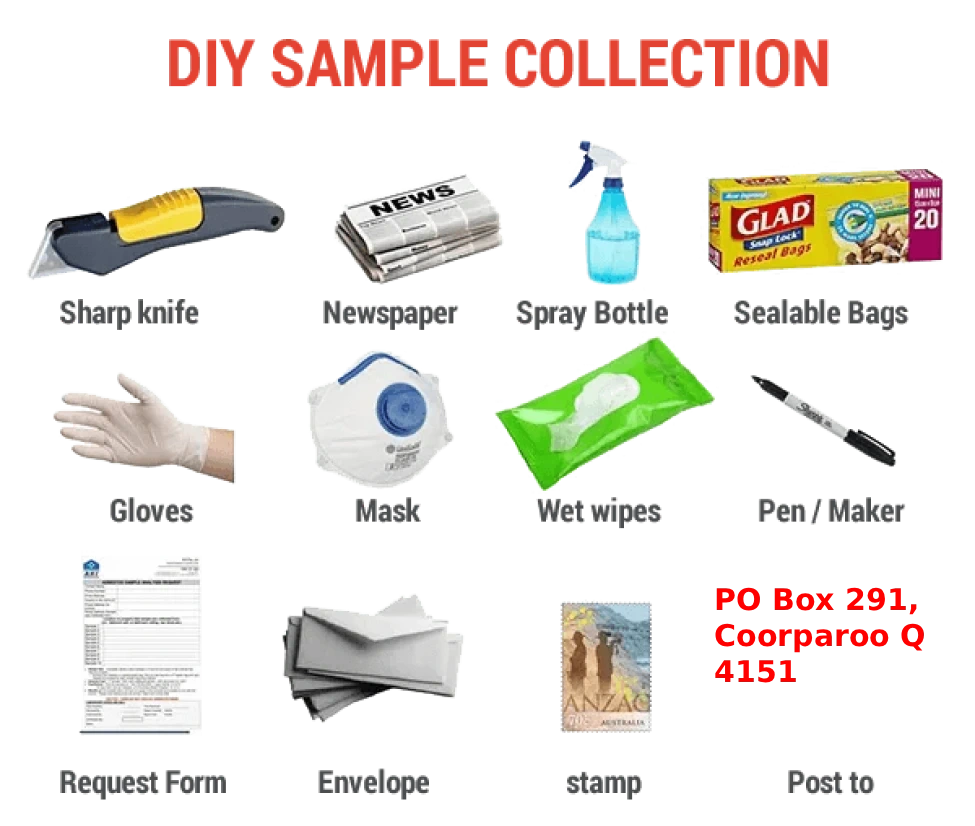
This is the process a proper asbestos sample collection follows, whether one of our technicians does it or you do:
If that list makes booking a technician sound like the easier option, that is the point we would make too. It is one call to have all fourteen steps done correctly the first time.
Once your sample reaches the lab, results are typically emailed back within 24 hours.
$54 for the first sample and $44 for each additional sample, GST inclusive. Ask about the cost of having a technician collect the sample for you when you book your consultation.
Payment is required before results are released. Direct deposit and credit card are both accepted.
All samples are analysed at a NATA-accredited laboratory in accordance with Australian Standard AS4964-2004, the same standard our technicians work to when they collect a sample on your behalf. NATA accreditation can be checked independently through NATA's register of accredited facilities.
If you would prefer one of AHI’s trained technicians to come and take the sample for you, please call our office for details.

In most cases, yes, for your own home. If the property is a workplace, a rental or under strata or body corporate management, there may be a legal duty to have a competent person assess it instead. Check the WHS Regulation 2011 (QLD) or ask us if you are unsure.
No. No test kit or visual check can confirm asbestos on the spot. Every sample, whether you collect it or a technician does, still needs to go to a NATA-accredited lab for a certain result.
Typically within 24 hours by email, once the lab has received your sample.
Treat it with extra caution and consider having a technician collect it instead. Friable materials release fibres far more easily than bonded materials such as vinyl tiles or fibro sheeting.
Lab analysis of a sample you collect yourself is $54 for the first sample and $44 for each additional one. Ask us for a quote on technician-collected sampling, which is often arranged as part of your consultation.
The asbestos experts here at AHI Asbestos Consultants share decades of experience in the asbestos industry; this gives us the scope to provide a comprehensive range of asbestos solutions for all commercial enterprises.
Other professional asbestos services we can provide include:
If you have any further queries about asbestos laws in Australia or our comprehensive range of services, contact our friendly help desk to arrange a consultation.
Taking your own sample is possible, and now you know what it involves. But asbestos is one of the few jobs around the house where the safest option and the easiest option are the same: let a licensed technician do it. AHI offers transparent pricing, fast turnaround and a 100% safety-compliant process from the first sample to the final report. Get in touch and we will take it from here.